
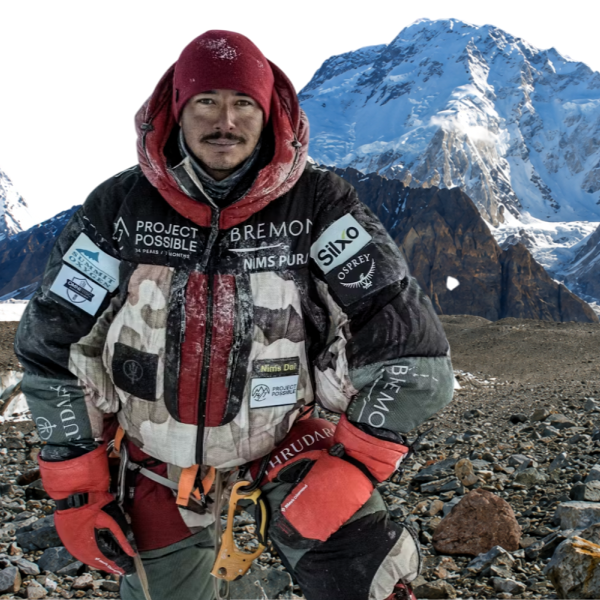

Who Was Nirmal "Nimsdai" Purja?
Born on 25 July 1983 in Myagdi District, Nepal, Nirmal Purja rose from humble beginnings to become one of the greatest high-altitude mountaineers in history. Before pursuing professional climbing, he served in the Brigade of Gurkhas of the British Army and later joined the United Kingdom Special Boat Service (SBS), one of the world's most elite special forces units. His military background became the foundation of the discipline, endurance, and leadership that later defined his mountaineering career. (Sources: Official Biography; Wikipedia; Netflix – 14 Peaks)
The Man Who Redefined Mountaineering
Nimsdai achieved international fame in 2019 with Project Possible, an ambitious mission to climb all 14 mountains above 8,000 metres in less than seven months. Defying expectations, he completed the challenge in an astonishing 6 months and 6 days, smashing the previous world record and inspiring millions around the globe. (Sources: Official Project Possible Records; Wikipedia; Netflix – 14 Peaks)

His achievements extended far beyond speed records. In January 2021, he led the historic first winter ascent of K2 as part of an all-Nepali team, accomplishing what many mountaineers had considered impossible. Throughout his career, he also set numerous climbing records, participated in high-altitude rescue missions, and became one of Nepal's most recognized ambassadors for mountaineering worldwide. (Sources: Wikipedia; Kathmandu Post)
Beyond the Summit
Nimsdai was admired not only for reaching summits but also for his commitment to helping others. He frequently participated in rescue operations at extreme altitude, advocated for greater international recognition of Nepali climbers, and promoted responsible adventure tourism through his expedition company, Elite Exped. His leadership inspired a new generation of Nepali mountaineers to dream bigger and lead expeditions on the world's highest peaks. (Sources: Kathmandu Post; Official Biography)
His Final Expedition & The Broad Peak Avalanche
During the 2026 summer climbing season, Nimsdai returned to Pakistan to lead an international expedition on Broad Peak (8,047m), the world's twelfth-highest mountain. Broad Peak, located in the Karakoram Range near K2, is known for its unpredictable weather, steep terrain, and significant avalanche risk despite often being overshadowed by its more famous neighbour. (Sources: National Geographic; Broad Peak references)
According to reports, Purja had recently shared his ambition to climb all fourteen 8,000-metre peaks twice without supplemental oxygen, continuing to push the boundaries of high-altitude mountaineering. (Source: The Guardian)

On 31 July 2026, a powerful avalanche struck the route between Camp II and Camp III on Broad Peak, sweeping through members of the climbing expedition. Rescue efforts involving helicopters, drones, and ground teams were immediately launched, but operations were repeatedly hampered by dangerous weather conditions, unstable snow, and the extreme environment of the mountain. (Sources: National Geographic; The Guardian; Kathmandu Post)
After days of uncertainty, Elite Exped released an official statement confirming the heartbreaking news that Nirmal "Nimsdai" Purja had lost his life in the avalanche. The company also confirmed that other members of the expedition had not survived, describing the tragedy as one of "profound sadness and immense heartbreak" while requesting privacy for the families and loved ones affected. (Source: Elite Exped Official Statement via Ratopati English)
A Legacy That Will Live Forever
Nirmal Purja transformed the image of Nepali mountaineers on the world stage. Through extraordinary achievements, fearless leadership, and an unwavering belief that impossible goals could be accomplished with determination and teamwork, he inspired climbers, adventurers, and dreamers across every continent.
His journey—from a Gurkha soldier to a global mountaineering icon—will remain one of the most remarkable stories in the history of Himalayan exploration. His achievements continue to inspire future generations to pursue excellence while respecting the immense power of the mountains. (Sources: Kathmandu Post; Wikipedia)
