
UV Radiation Isn't Heat: Why You Can Get Sun Damage on a Cool Day
The temperature tells you how the air feels. The UV Index tells you something much more important about ultraviolet exposure.

There is a simple assumption many of us make when we step outside:
If the sun feels strong, UV must be high.
And the opposite:
If the day feels cool, the UV must be low.
It sounds logical.
It is also one of the most important misunderstandings about sun exposure.
Ultraviolet radiation is not heat.
It cannot be seen.
It cannot be felt.
And its intensity does not simply rise and fall with the temperature shown on a weather app.
That distinction matters on an Australian beach, during an outdoor sporting event, on a cloudy hiking day — and eventually, somewhere much higher above sea level.
Cancer Council Australia specifically explains that UV can be high on cool and overcast days and that temperature and clear skies should not be used as the sole indicators of whether sun protection is needed.
A continuation of the conversation
In the previous article, “Why Australia Talks About Skin Cancer: Understanding the Sun Beyond the Beach,” we looked at why skin cancer has become such a familiar public-health conversation in Australia.
We looked at the relationship between UV exposure and skin cancer, why accumulated exposure matters, and why sun protection is not simply a beach activity.
That discussion left us with a more fundamental question:
If UV is responsible for the damage, what exactly is UV?
And perhaps more importantly:
Why can the skin receive significant UV exposure when the weather itself feels completely harmless?
That is where the science becomes much more interesting.

Why Australia Talks About Skin Cancer: Understanding the Sun Beyond the Beach
Discover why skin cancer is a central conversation in Australia, how accumulated UV radiation damages skin over time, and why sun safety isn't just for hot beach days.
Read Previous Article →What actually is ultraviolet radiation?
Ultraviolet radiation is one component of the energy produced by the sun.
The sunlight we experience is not one single type of radiation.
For everyday understanding, it helps to separate it into three broad components:
- Visible light — what our eyes see.
- Infrared radiation — strongly associated with the warmth we feel.
- Ultraviolet radiation — invisible to our eyes and not detectable as heat by our skin.
This last category is the one that matters most when discussing UV-related skin damage.
Cancer Council Australia describes UV as the invisible component of solar radiation and distinguishes it from infrared radiation, which we experience as heat.
This explains an apparently strange outdoor experience:
You can be cold and still receive substantial UV exposure.
There is no contradiction.
The temperature and the UV level are measuring different aspects of the environment.
UVA, UVB and UVC: three names, different behaviour
The word “UV” describes a range of ultraviolet radiation rather than a single wavelength.
Scientists generally divide it into three bands:
UVA
UVA has longer wavelengths and penetrates more deeply into the skin. It contributes to long-term skin changes such as premature skin ageing and also contributes to skin cancer.
UVB
UVB has shorter wavelengths and higher energy than UVA. It is strongly associated with sunburn and plays an important role in skin damage and skin cancer.
UVC
UVC has even shorter wavelengths and is highly energetic. Naturally occurring solar UVC is absorbed by the Earth's atmosphere and does not normally reach the surface.
So when we talk about ordinary exposure from the sun, the important surface-level conversation is primarily about UVA and UVB.
Both matter.
Cancer Council Australia notes that UVA contributes to long-term skin damage and skin cancer, while UVB is a major cause of skin damage and skin cancer. Broad-spectrum sunscreen is designed to provide protection against both.
The important distinction: heat is not UV
Now we can return to the original question.
Why can a cool day still have significant UV?
Because heat and UV are not the same form of solar radiation.
Infrared radiation contributes to the sensation of warmth.
UV does not.
Therefore:
- Hot ≠ automatically high UV.
- Cold ≠ automatically low UV.
- Cloudy ≠ automatically safe.
This is why Cancer Council Australia recommends checking the UV Index rather than relying on temperature, cloud cover or how bright the day appears.
The practical lesson is remarkably simple:
The weather tells you how the day feels. The UV Index tells you when sun protection is needed.
Why a cool day can still have strong UV
UV levels are affected by several environmental factors.
Among the most important are:
- the height of the sun in the sky;
- latitude;
- season;
- time of day;
- altitude;
- cloud cover;
- ozone;
- scattering;
- reflection from surrounding surfaces.
ARPANSA explains that the height of the sun is one of the most important factors affecting solar UV at the Earth's surface. When the sun is higher in the sky, solar radiation travels through less atmosphere before reaching the surface, meaning less UV is absorbed along the way.
This gives us an important distinction:
Temperature is primarily describing the thermal environment.
UV is describing the ultraviolet radiation environment.
They interact with the same sun, but they are not interchangeable measurements.
Cloud makes the picture even more complicated
Cloud is another reason people underestimate UV.
Look outside.
The sky is grey.
The sun is not obvious.
The air feels cooler.
It seems like the perfect day to forget about sunscreen.
But the atmosphere does not work according to appearances.
Heavy cloud can substantially reduce UV.
However, thin or broken cloud may allow considerable UV through, and scattering around clouds can sometimes increase local UV exposure.
The World Health Organization specifically warns against underestimating UV passing through clouds and notes that thin cloud may have relatively little effect.
Cancer Council Australia therefore makes the point very clearly: You cannot use cloud cover alone to decide whether protection is necessary.
The “cool breeze” problem
There is another subtle trap.
Imagine walking outside on a warm but windy day.
The breeze cools your face and arms.
The sunlight does not feel particularly intense.
Hours later, the skin is red.
People sometimes call this “windburn.”
But wind itself does not produce sunburn.
If the skin has reddened after UV exposure, it may actually be a sunburn that was masked by the cooling sensation of the wind.
Cancer Council Australia specifically addresses this misconception and notes that there is no such thing as “windburn” in the sense of wind producing UV-type sunburn.
That is another example of the same underlying problem: our senses are not reliable UV meters.
So what should we use instead?
The UV Index
The UV Index is designed to translate ultraviolet radiation into a simple numerical scale that can guide sun-protection behaviour.
Cancer Council Australia uses these categories:
| UV Index | Category |
|---|---|
| 1–2 | Low |
| 3–5 | Moderate |
| 6–7 | High |
| 8–10 | Very High |
| 11+ | Extreme |
Cancer Council Australia recommends following its SunSmart protection measures when the UV Index reaches 3 or above.
This is one of the most useful ideas to carry from the Australian conversation into international travel.
Instead of asking: “Is it hot?”
Ask: “What is the UV Index?”
Why the UV Index is a better travel question
Imagine two days.
Day A
Temperature: 30°C
Clear sky.
Strong sunlight.
Day B
Temperature: 14°C
Cool breeze.
Thin cloud.
Which day has more UV?
You cannot answer reliably from those two temperature readings.
The UV level depends on the wider environmental conditions.
That is why the UV Index exists.
And this becomes particularly important when travellers cross climate zones.
A person can leave a warm Australian city and arrive somewhere substantially colder without automatically entering a low-UV environment.
What happens to UV during the day?
UV does not remain constant throughout the day.
As the sun rises higher in the sky, the path through the atmosphere becomes shorter and UV intensity generally increases.
This is why UV protection is especially important around the middle of the day when the sun is high.
The precise timing varies with location and season.
ARPANSA identifies sun elevation, time of day, season and geographic position among the important factors influencing UV levels.
This also explains why the same clock time can mean different UV conditions in different parts of the world.
And then there is latitude
Latitude changes the angle at which solar radiation reaches the Earth.
In general, places closer to the equator can experience higher UV levels because the sun can reach higher elevations in the sky.
This is one of several reasons Australia can experience substantial UV exposure.
It also becomes relevant when thinking about Nepal.
Nepal sits considerably closer to the equator than much of Europe, although its geography and enormous changes in elevation mean that UV conditions vary substantially across the country.
That combination — latitude plus altitude — becomes particularly interesting when discussing Himalayan travel.
The altitude question
This is where the article moves naturally from Australian sun safety into mountain science.
We have established that:
- UV is not heat;
- cold does not automatically mean low UV;
- clouds do not eliminate UV;
- UV changes with geography;
- UV changes with time of day.
Now add another variable: Altitude.
The higher you go, the less atmosphere there is above you.
That means there is less atmospheric absorption of UV radiation.
The World Health Organization states that UV levels increase by approximately 10% for every 1,000 metres of altitude.
ARPANSA similarly identifies altitude as an important influence on UV and gives a range of approximately 10–12% per 1,000 metres in its UV guidance.
The exact UV environment of any particular mountain cannot be calculated from altitude alone.
But the principle is important: As elevation increases, UV exposure generally increases.

The higher you climb, the colder it can become — while UV becomes more important
This is one of the reasons mountain environments can confuse first-time trekkers.
You climb higher.
The temperature drops.
The wind becomes colder.
You add layers.
You may even see snow.
Everything about your body tells you: “The sun is no longer the problem.”
But the atmosphere tells a different story.
At altitude, there is less atmosphere available to absorb UV.
And if snow or another reflective surface is present, the environment can introduce additional exposure.
The World Health Organization estimates that UV increases by approximately 10% per 1,000 metres and notes that fresh snow can almost double UV exposure through reflection.
This is where mountain travel stops being simply a question of “sunny or cloudy.”
It becomes a question of environmental exposure.
Snow changes the story again
Snow is visually associated with cold.
UV is not.
Fresh snow is a highly reflective surface.
WHO notes that fresh snow can almost double a person's UV exposure and highlights the importance of accounting for ground reflection in environments such as skiing and high-altitude travel.
This is why the mountain traveller's equipment needs to address more than warmth.
The face may need protection.
The eyes need protection.
Exposed skin needs protection.
And the combination of altitude, reflection and long outdoor periods deserves consideration.
From Australia to the Himalayas: the connection is environmental, not promotional
This is where the conversation between Australia and Nepal becomes genuinely useful.
Australia has developed a particularly strong public understanding of UV because skin cancer is such a significant public-health issue.
The lesson Australia offers is straightforward: Don't judge UV by temperature.
Nepal introduces a different environment in which that lesson becomes especially interesting.
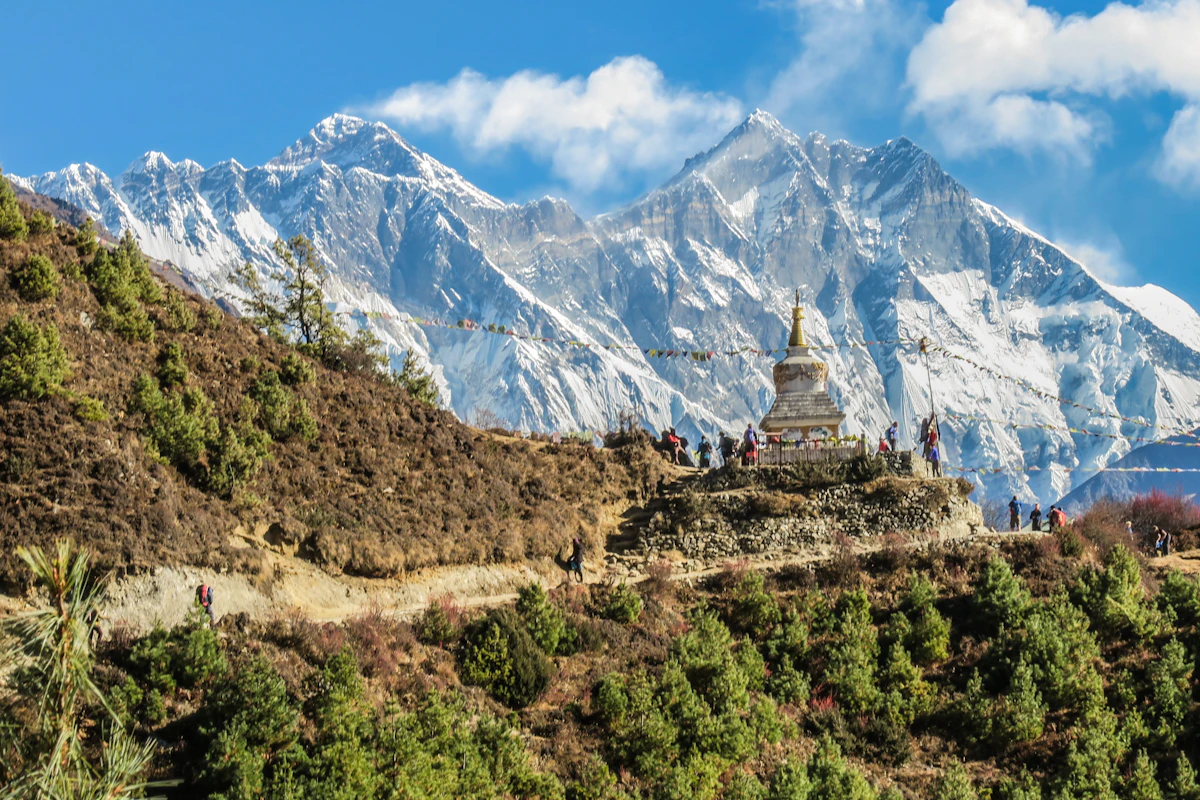
The Himalayas add: altitude, exposed terrain, snow, reflection and long days outdoors.
The underlying radiation has not changed.
The environment around the traveller has.
And that is the more useful way to connect the two destinations.
What does this mean for someone travelling to Nepal?
It does not mean that every traveller to Nepal should think of the mountains as a dangerous UV environment.
Nor does it mean that people should avoid outdoor experiences.
Quite the opposite.
It means that understanding the environment can make the experience better.
A trekker preparing for Nepal should think beyond: “Will it be cold?”
They can also consider:
- How high will I be?
- How long will I spend outside?
- Will the route be exposed?
- Will there be snow or other reflective surfaces?
- What does the UV forecast indicate?
- Which areas of my skin remain exposed?
- Do I have appropriate sunglasses?
- Do I have a suitable hat?
- Am I using sunscreen appropriately?
These are preparation questions rather than reasons for alarm.
Why this matters particularly on trekking days
A traveller spending 20 minutes walking between buildings is having a very different exposure experience from someone trekking for six or eight hours.
Mountain trekking can involve long periods outdoors with relatively little shade.
The environment can also change during a single day.
A route may begin in forest.
Then emerge into open terrain.
Then climb above the tree line.
Then cross snow or exposed rock.
The UV environment can therefore change as the landscape changes.
This is one reason mountain preparation cannot be reduced to a single weather forecast.
The Himalayan landscape is a changing environment
Nepal's geography makes this particularly visible.
A journey can move from greener, forested environments into increasingly open mountain terrain.
The traveller notices the changes in vegetation.
The air becomes different.
The temperature changes.
The terrain changes.
The horizon expands.
At higher elevations, the landscape becomes increasingly exposed.
This is what makes Himalayan travel so extraordinary.
But it is also why understanding environmental factors matters.
The mountain is not simply a colder version of the place you started.
It is a different environment.
Mountain Tiger Nepal: our role in this conversation
This is where Mountain Tiger Nepal has a legitimate role to play.
Not as the source of the medical science.
The scientific evidence belongs to organisations such as Cancer Council Australia, the World Health Organization and ARPANSA.
Our role is different.
We operate in the environment that the science is describing.
Mountain Tiger Nepal works with travellers across Nepal's changing landscapes — from lower-altitude cultural and nature experiences to trekking environments where altitude, weather, terrain, exposure and preparation become increasingly relevant.
That gives us a practical responsibility: To translate destination knowledge into traveller awareness.
Not to diagnose.
Not to replace doctors.
Not to turn every environmental issue into a warning.
But to help travellers understand what they are entering.
What we believe at Mountain Tiger Nepal
For us, responsible Himalayan travel begins with respect for the environment.
That respect includes the obvious things:
- Respect for local communities.
- Respect for mountain ecosystems.
- Respect for weather.
- Respect for altitude.
- Respect for trails.
- Respect for the people who live and work in the mountains.
But it also includes something less visible: Respect for the physical conditions affecting the traveller.
UV is one of them.
It is invisible.
It does not announce itself.
And precisely because it is easy to overlook, it belongs in the wider conversation about mountain preparation.
Mountain Tiger Nepal's perspective: knowledge before elevation
We often think of preparation for a Himalayan journey in terms of altitude acclimatisation, fitness, clothing and logistics.
But preparation is broader than that.
The more you understand your environment, the more intelligently you can respond to it.
That means knowing that:
- cold does not mean low UV;
- cloud does not mean zero UV;
- higher altitude generally means greater UV exposure;
- snow can reflect UV;
- and long outdoor exposure adds up.
These are not reasons to fear the mountains.
They are reasons to understand them.
And that is the philosophy we want to bring to Himalayan travel.
The Australian lesson becomes a Himalayan habit
There is something particularly useful about taking an Australian sun-safety habit and applying it to mountain travel.
Australia has spent decades teaching people: Check the UV, not just the weather.
For a Himalayan traveller, that becomes: Read the environment, not just the temperature.
Temperature is one piece.
Altitude is another.
Weather is another.
Terrain is another.
Duration is another.
Reflection is another.
Preparation brings them together.
A practical way to think about a mountain day
Imagine a trekking day begins at 7°C.
The sky is partly cloudy.
The trail is exposed for several hours.
The route climbs another 800 metres.
Later in the day, snow appears.
The traveller might reasonably think: “It is cold. I need more layers.”
Correct.
But the environmental assessment should not stop there.
The traveller should also think:
- “I am climbing higher.”
- “I am spending hours outdoors.”
- “The terrain is becoming more exposed.”
- “There may be reflective snow.”
- “I should check the UV conditions and maintain appropriate protection.”
That is the kind of environmental awareness that matters.
Sunscreen remains only one part of the mountain equation
The lesson from Australia remains useful here.
Sun protection is not simply about applying sunscreen.
A broader strategy includes:
- Clothing: Covering exposed skin where practical.
- Hat: Protecting the face, ears and neck.
- Sunglasses: Protecting the eyes from UV.
- Shade: Using natural or built shade when available.
- Sunscreen: Protecting areas that remain exposed.
Cancer Council Australia's SunSmart guidance recommends these five forms of protection when the UV Index is 3 or above.
For mountain travel, these principles can be adapted to the realities of the trail.
The point is not to fear the sun
This distinction matters.
There is a danger in turning every health discussion into a warning.
The objective is not to make people afraid of outdoor travel.
Sunlight is part of our environment.
Outdoor activity has enormous physical, psychological and cultural value.
And travel is one of the ways people experience environments they would otherwise never encounter.
The better approach is informed participation.
Know the conditions.
Prepare accordingly.
Then enjoy the landscape.
Why this matters for international travellers
Someone travelling from Australia to Nepal does not leave behind everything they know about the sun.
In fact, their existing sun-safety knowledge becomes useful.
What changes is the environment in which that knowledge is applied.
The beach becomes a trail.
The ocean becomes a mountain horizon.
Sea-level exposure becomes high-altitude exposure.
Sand and water may be replaced by snow and rock.
The temperature may fall.
The UV does not necessarily fall with it.
That is the real connection between the two countries.
Australia teaches the question. The Himalayas expand it.
The first article asked why Australia talks so much about skin cancer.
This article answers one of the reasons that conversation matters: because our senses are not reliable guides to UV exposure.
The next question follows naturally.
If UV can remain significant on a cool day, and if altitude can increase UV exposure, then:
- What actually happens as we climb higher into the Himalayas?
- How significant is the altitude effect?
- How does snow reflection change exposure?
- What does “above the tree line” mean for a traveller?
- And how should a person prepare for a full day in a high-altitude environment?
That is where the science gets even more interesting.
The mountain is telling you more than the thermometer
Perhaps that is the simplest way to remember everything in this article.
A thermometer tells you about temperature.
A cloud tells you something about weather.
A landscape tells you something about terrain.
An altitude reading tells you how high you are.
But none of these alone tells you the full UV story.
For that, check the UV Index and understand the environment around you.
From the Australian coast to the Nepal Himalayas
There is a fascinating continuity here.
Australia's beaches and outdoor culture helped create one of the world's most recognisable sun-safety conversations.
Nepal's mountains provide a completely different setting in which the same fundamental science becomes relevant.
The lesson travels well:
- UV is invisible.
- Heat is not UV.
- Cloud does not guarantee safety.
- Altitude generally increases UV exposure.
- Snow can reflect it.
- Duration matters.
- And preparation is better than discovering the problem after the skin has already reacted.
Mountain Tiger Nepal: our perspective from the ground
At Mountain Tiger Nepal, our connection to this subject is ultimately about the traveller.
We are not presenting ourselves as a medical research organisation.
We are a Nepal-based travel and destination-management company whose teams work within the environments being discussed.
Our value lies in knowing how a journey actually unfolds.
Where travellers spend their time.
How routes change.
How altitude changes the landscape.
How weather can shift.
Where exposure becomes greater.
What preparation makes sense.
And how to communicate these realities before a traveller reaches the trail.
That is why we believe destination knowledge should extend beyond: where to go.
It should also explain: what the environment is doing while you are there.
Our role is not to make the Himalayas sound riskier.
It is to make travellers more prepared to appreciate them.
That distinction matters to us.
Nepal does not need to be marketed through fear.
The Himalayas do not need exaggerated warnings to make them impressive.
They are already extraordinary.
Our responsibility is to help travellers understand them properly — so that the experience is not only memorable, but informed.
From the first briefing to the final trail, that knowledge becomes part of the journey.
Mountain Tiger Nepal is proud to be part of that journey — not simply as a company taking travellers into the Himalayas, but as a Nepal-based team that understands the environments through which those journeys move.
The takeaway
Don't use temperature as a substitute for the UV Index.
A day can be cold.
A day can be cloudy.
A day can be windy.
A day can even be surrounded by snow.
And UV exposure can still matter.
For travellers, the lesson becomes even more important as the environment changes.
- Check the UV.
- Understand the altitude.
- Consider reflection.
- Think about duration.
- Use layers of protection.
And then get on with what brought you outside in the first place: experience the world.
Where this conversation goes next
The previous article took us from Australia's skin-cancer conversation to the basic science of UV.
This article separated UV from heat.
The natural next step is to go higher.
Does Altitude Increase UV Exposure?
From Australian sun-safety guidance to the high Himalayas, the next discussion will look more closely at what happens when elevation increases — and why a colder environment can sometimes create a more demanding UV environment.
For travellers preparing for Nepal, that is not just an interesting scientific question.
It is part of understanding the mountain itself.
Sources & Further Reading
- Cancer Council Australia — UV Index — Date not stated. Official source
- Cancer Council Australia — Do you only need sun protection if it is a hot, sunny day? — Date not stated. Official source
- Cancer Council Australia — UV: Skin damage you can't see — Date not stated. Official source
- Cancer Council Australia — All about sunscreen: 101 basics — Date not stated. Official source
- Cancer Council Australia — Skin cancer: cause, symptoms and risks — Updated 30 July 2026. Official source
- World Health Organization — Radiation: Ultraviolet (UV) radiation — page published 9 March 2016. Official source
- World Health Organization — Ultraviolet radiation — 21 June 2022. Official source
- Australian Radiation Protection and Nuclear Safety Agency (ARPANSA) — Exposure from ultraviolet radiation: Frequently Asked Questions — Date not stated. Official source
